






Service monitoring
Status of the Bucharest metro
Service status · based on the published timetable
M1 · Line 1 (Yellow)
M2 · Line 2 (Blue)
M3 · Line 3 (Red)
M4 · Line 4 (Green)
M5 · Line 5 (Orange)
Are you looking for information about the Bucharest metro? Below you will find all the information about timetables, ticket prices, itineraries, stations, stops and routes of the Bucharest metro. Click on the image of the metro line that interests you.
Bucharest metro line
We provide you with all the information about the Bucharest metro stations and their route.
You can click on the name of any station to find additional information about any of them.
You can find information such as the location of each station, the entrances to the stations, nearby buses, hotels, restaurants, information points and other aspects of interest to metro passengers or travellers.
Bucharest Metro Map PDF
Below you have a map of the Bucharest metro and its lines, which you can view and download if you wish.
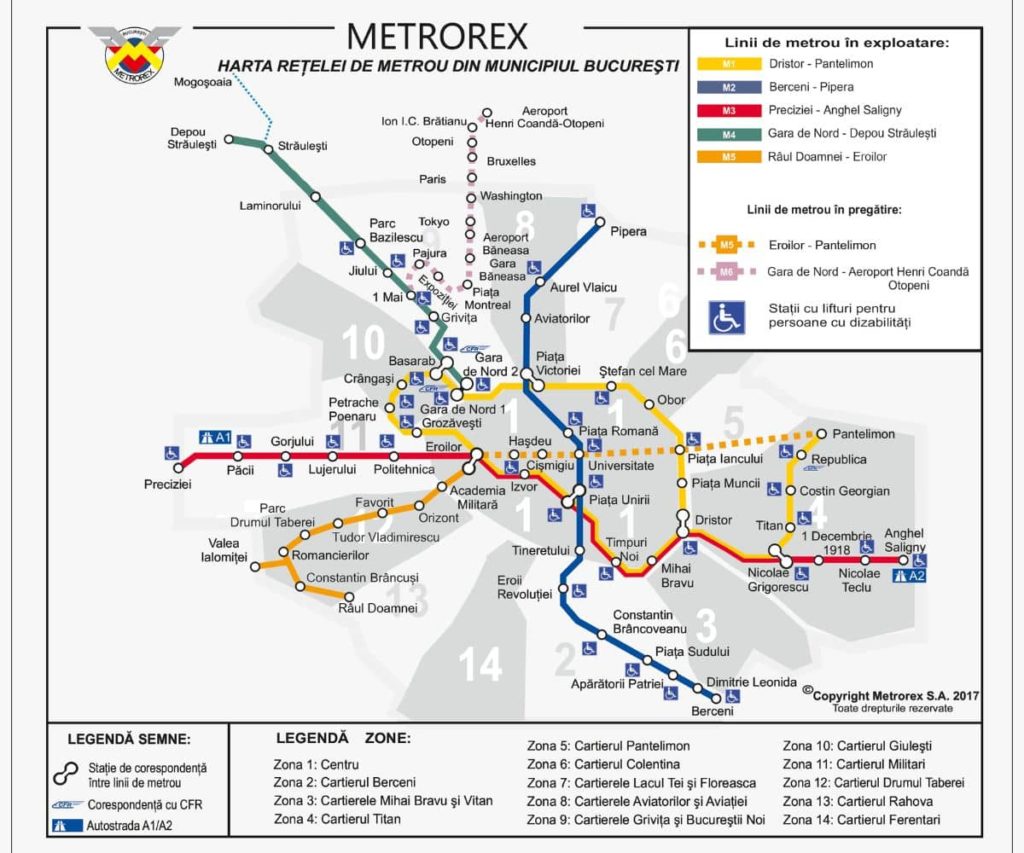
If you prefer, you can download it and print it by clicking here.
The design of the Bucharest metro map is intended to be clear and easy for users to understand, allowing them to plan their routes and navigate the system efficiently. It is important to bear in mind that the details of the map may change over time due to expansions, modifications and upgrades to the system.
Bucharest metro stations
The Bucharest metro stations are as follows: Pantelimon, Republica, Costin Georgian, Titan, Nicolae Grigorescu 1, Dristor 1, Mihai Bravu, Timpuri Noi, Piața Unirii 1, Izvor, Eroilor, Grozăvești, Petrache Poenaru, Crângași, Basarab, Gara de Nord 1, Piața Victoriei 2, Ștefan cel Mare, Obor, Piața Iancului, Piața Muncii, Dristor 2, Tudor Arghezi, Berceni, Dimitrie Leonida, Apărătorii Patriei, Piața Sudului, Brâncoveanu, Eroii Revoluției, Tineretului, Piața Unirii 2, Universitate, Piața Romană, Piața Victoriei 1, Aviatorilor, Aurel Vlaicu, Pipera, Preciziei, Păcii, Gorjului, Lujerului, Politehnica, 1 Decembrie 1918, Nicolae Teclu, Anghel Saligny, Gara de Nord 2, Grivița, 1 Mai, Jiului, Parc Bazilescu, Laminorului, Străulești, Râul Doamnei, Constantin Brâncuși, Valea Ialomiței, Parc Drumul Taberei, Tudor Vladimirescu, Favorit, Orizont, Academia Militară.
Lines and colours: Each metro line is shown on the map in a distinctive colour to make it easier to identify visually. The colours used are yellow for M1, blue for M2, red for M3, green for M4 and orange for M5. The names and numbers of the lines are shown next to the coloured lines, so that passengers can identify them easily.
Stations: Metro stations are shown on the map as dots along the lines. Each station is identified by its name, which often reflects its geographic location or nearby landmarks. Some stations may be interchange stations between different lines, which is clearly indicated on the map.
Bucharest metro routes
At present, and as can be seen on the map, there are 5 metro routes:
- M1 Pantelimon – Dristor 2
- M2 Tudor Arghezi – Pipera
- M3 Preciziei – Anghel Saligny
- M4 Gara de Nord 2 – Străulești
- M5 Râul Doamnei – Eroilor
Metro season tickets
Below you will find information about the normal and special fares of the Bucharest metro. In addition, you can see the prices of the weekly, monthly and annual season tickets.
Metro timetable
We provide you with the metro timetables, so that you know this relevant information in case you plan to travel.
Official Metrorex information
This site is an independent information guide, published by GoRandom (Basque Country, Spain) and funded by advertising. It is not affiliated with Metrorex or STB and cannot answer on behalf of the operator.
For official information, complaints or lost property, contact Metrorex directly through its official website metrorex.ro or at the station ticket offices.
The history and opening of the Bucharest metro
The Bucharest metro is the underground transport network of Romania’s capital, run by the operator Metrorex. Here are the main stages of its development:
The beginnings: the first plans for a metro in Bucharest date from the 1930s, but construction only began in 1975. The first section of line 1, Semănătoarea (now Petrache Poenaru) – Timpuri Noi, opened on 16 November 1979.
The 1980s: M1 was extended to Republica (1981), Crângași (1984), Gara de Nord (1987) and Dristor 2 (1989). In 1983 the Eroilor – Industriilor (now Preciziei) branch opened, today the western part of M3. Line 2 opened on 24 January 1986 between Piața Unirii and Depoul IMGB (now Berceni) and reached Pipera on 24 October 1987.
The 1990s–2000s: Pantelimon station opened in 1991, and the first section of line 4, Gara de Nord – 1 Mai, in 2000. On 20 November 2008 the Nicolae Grigorescu – Anghel Saligny section opened; together with the branch to Preciziei it forms today’s M3.
The 2010s–2020s: M4 was extended to Parc Bazilescu (2011) and Străulești (2017). Line 5 opened on 15 September 2020 between Eroilor and Râul Doamnei / Valea Ialomiței, and on 15 November 2023 Tudor Arghezi became the new southern terminus of M2.
Today: the network has 5 lines (M1–M5), 64 stations and about 80 km of route. Line M6, to Henri Coandă Airport, is under construction.
Frequently asked questions
The Bucharest metro (Metrorex) has 5 lines — M1, M2, M3, M4 and M5 — with 64 stations and about 80 km of route. The M6 line (Gara de Nord – Henri Coandă Airport) is under construction and not yet open.
Tickets and passes are sold at the machines and ticket offices in the stations: cards with 1, 2 or 10 journeys and passes for 24 hours, 72 hours, 7 days, one month, 6 months or a year. Passes are loaded onto contactless cards. You can also pay directly at the turnstile, contactless, with a bank card or phone — this works on all lines.
Since 1 May 2026, one journey costs 7 lei, 2 journeys 14 lei and 10 journeys 55 lei. The 24-hour pass costs 18 lei, the 72-hour pass 50 lei, the weekly pass 60 lei, the monthly pass 140 lei and the annual pass 1,300 lei. Fares are the same on all 5 lines. For the metro plus STB buses and trams there are integrated passes (for example 23 lei for 24 hours). All fares are on our tickets and passes page.
At interchange stations you can change lines without leaving the station and without paying again. The main interchanges are: Piața Unirii (M1/M3 and M2), Piața Victoriei (M1 and M2), Eroilor (M1/M3 and M5) and Basarab (M1 and M4); between M1 and M3 you can change at any station on the shared Eroilor – Nicolae Grigorescu section. At Gara de Nord the M1 and M4 stations are not connected inside the paid area: to change between M1 and M4 without exiting, use Basarab.
The Bucharest metro runs daily between approximately 5:00 and 23:00. The last trains leave the terminus stations around 23:00, so plan your final journey accordingly. The timetable is similar at the weekend, but with slightly longer intervals between trains.
The frequency depends on the line, the day and the time: trains are more frequent at peak times, and intervals are longer in the evening, at weekends and on public holidays. On the M5 branches (Râul Doamnei and Valea Ialomiței) and at the Pantelimon end of M1 trains are less frequent, because only some of them run that far. The detailed timetable for each line is available in the Timetable section.
No. At present the metro does NOT reach Henri Coandă International Airport (Otopeni). The airport is linked to the city by the CFR train that departs from Gara de Nord (around 20 minutes) and by the STB express bus line 100, between Piața Unirii and the airport (stopping at Universitate, Piața Romană and Piața Victoriei). The M6 metro line (Gara de Nord – Henri Coandă Airport) is under construction, with its opening estimated around 2028.
Yes. A journey is valid across the whole network until you exit the station, so you can change between lines at interchange stations (for example Piața Unirii or Piața Victoriei) without using a new journey.
Yes. Pupils get a free monthly pass, and students get free passes or a 90% discount (since 1 May 2026: monthly pass 14 lei, 10 journeys 5.50 lei), as provided by law. Blood donors get a reduced monthly pass (70 lei). To benefit from them you must present the supporting documents at the ticket offices.